
<img height="1" width="1" style="display:none;" alt="" src="https://px.ads.linkedin.com/collect/?pid=10254505&amp;fmt=gif">

Join us for the next Cause Mapping Root Cause Analysis Public Workshop in HOUSTON, TX on October 27-29, 2026.

Six Common Errors of Problem Solving

Mark Galley-1Mark Galley
President & Root Cause Analysis Facilitator

Organizations use all kinds of tools for problem solving and root cause analysis (RCA). The approaches vary, but the same mistakes show up again and again.

  1. Stopping at human error
  2. Looking for one root cause
  3. Defining the problem by a cause
  4. Mistaking the description for the analysis
  5. Classifying causes instead of connecting them
  6. Treating problem solving as a collection of separate tools

These errors can make an investigation feel complete before the organization actually understands what happened. Avoiding them starts with a few basic problem-solving principles.


1. Ask Why the Error Occurred

When someone skips a step, makes the wrong selection, or forgets something, it is easy to identify that action as the problem. After all, if the person had done something differently, the incident might not have happened. But that still leaves an important question unanswered: Why did the error occur?

Consider something as simple as locking your keys in your car. You already knew not to do it. Punishing yourself afterward would not explain why it happened or make it less likely to happen again. Prevention requires changing something, such as putting the keys in your pocket before closing the door or keeping a spare available.

The same logic applies at work. If someone did not follow a procedure, the investigation should explain why. Was this the first time the step was missed, or is it commonly done this way? Is the person new to the task, or did they learn to perform it this way from someone else? Does the procedure reflect how the work is actually performed?

“Did not follow procedure” may be a cause, but it is not a complete explanation. Human error should lead to questions about the conditions and work processes that allowed it to occur.


2. Look for the Causes, Not the Cause

Many problem-solving approaches are built around the idea that there is one root cause and that the investigator’s job is to find it. This seems reasonable. If one thing can be identified as the root cause, fixing that one thing should prevent the problem from happening again.

The difficulty is that problems do not work that way. Ask four people to name the most important part of a car and you might hear the engine, the battery, the key, and the driver. Each answer makes sense because without any one of them, the car does not go.

Fire provides another simple example. Heat, fuel, and oxygen are all required. Remove any one and the fire does not occur. That does not make one the “real” cause and the others merely contributing factors. They work together to produce the effect.

Incidents work the same way. Multiple causes combine to produce a result, which means there are usually multiple opportunities to prevent it. A thorough analysis shows how the causes worked together so the organization can determine where changes will be most effective.

"Multiple causes combine to produce a result, which means there are usually multiple opportunities to prevent it."


3. Start the Analysis with the Impact to the Goals

Ask a group of people, “What’s the problem?” and you may get several different answers. Maintenance may say the problem was a seal failure. Operations may say the backup pump never should have been out of service. Someone else may say the seal flush was set incorrectly.

The tendency is to argue over which one is the “real problem.” In reality, all three may simply be different causes within the same incident.

Starting with the organization’s goals provides a common reference point. Was there an injury? Was production interrupted? Was equipment damaged? Was there an environmental or customer impact? People may disagree about the causes while readily agreeing about these impacts.

Once the impact is clear, the investigation can work backward by asking why it occurred. What initially appeared to be competing definitions of the problem can become part of the same cause-and-effect analysis.


4. Make Cause-and-Effect Relationships Visible

A problem description can capture what happened, but it does not always make the cause-and-effect relationships easy to see. That matters because analysis is not just a collection of facts. It explains why something happened by showing how the causes connect.

Consider this example:
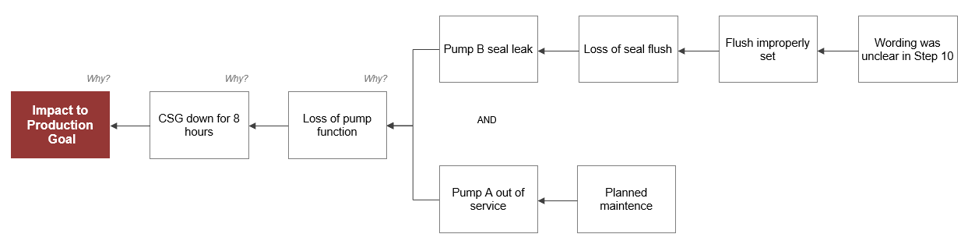
On October 14, 2004, there was a pump failure that resulted in the loss of the CSG unit for approximately eight hours. The loss of the pump function was due to a seal leak on Pump B. The seal flush was lost because it had been set improperly after an overhaul of the pump. Pump A was out of service because of routine maintenance.

The description tells us what happened. The analysis explains why it happened by building backward through cause and effect. Why was the CSG unit down for eight hours? Because pump function was lost. Why was pump function lost? Because Pump B had a seal leak AND Pump A was out of service.

That AND is important. The loss of pump function required two causes, so the analysis splits into two branches. As an analysis grows, these relationships can become difficult to communicate in sentences and paragraphs. A visual cause-and-effect diagram makes the connections much easier to see.

Pump Failed 8-Why Cause Map™
*Click to expand


5. Apply the Basics of Cause-and-Effect, Not Labels

A problem description can capture what happened, but it does not always make the cause-and-effect Organizations use all kinds of labels for causes: root cause, immediate cause, basic cause, contributing cause, human cause, system cause, and many others. These terms are intended to add clarity, but they often create disagreement about what to call a cause instead of whether it actually caused an effect.

A simpler approach is to ask: Did this cause this effect? If the evidence supports the relationship, it is a cause. If the relationship is possible but not yet supported by evidence, it is a possible cause that needs to be investigated. The important part is the cause-and-effect relationship and the evidence that supports it—not labels.


6. Apply the Same Basic Principles Across Different Problems

Organizations often use different problem-solving tools for different situations. A safety incident may have one process while a completely different approach may be used for an equipment failure. Different tools can be useful, but the basic principles of problem solving do not change. Whether the issue involves safety, production, equipment, quality, or customer service, the same questions still apply: What happened? Which goals were affected? Why did it happen? What evidence supports the cause-and-effect relationships? And what are we specifically going to do to prevent this issue.

The level of detail in the analysis may change, but the underlying approach does not. Cause-and-effect provides a consistent foundation.


Learn about root cause analysis training and investigations